The Meta Ad Creative Optimisation Guide for Luxury Brands
Learn 303's three-pillar Meta creative framework for luxury brands, from foundations to testing, variety, and fatigue tracking.

There's a tension every luxury brand faces on Meta: you need the platform to perform, but you can't let it make your brand look cheap. Heavy-handed CTAs, badge-laden graphics, and algorithm-chasing creative can erode years of brand equity in a single campaign.
The good news is that the two goals, performance and brand integrity, are not mutually exclusive. They just require a different approach to creative.
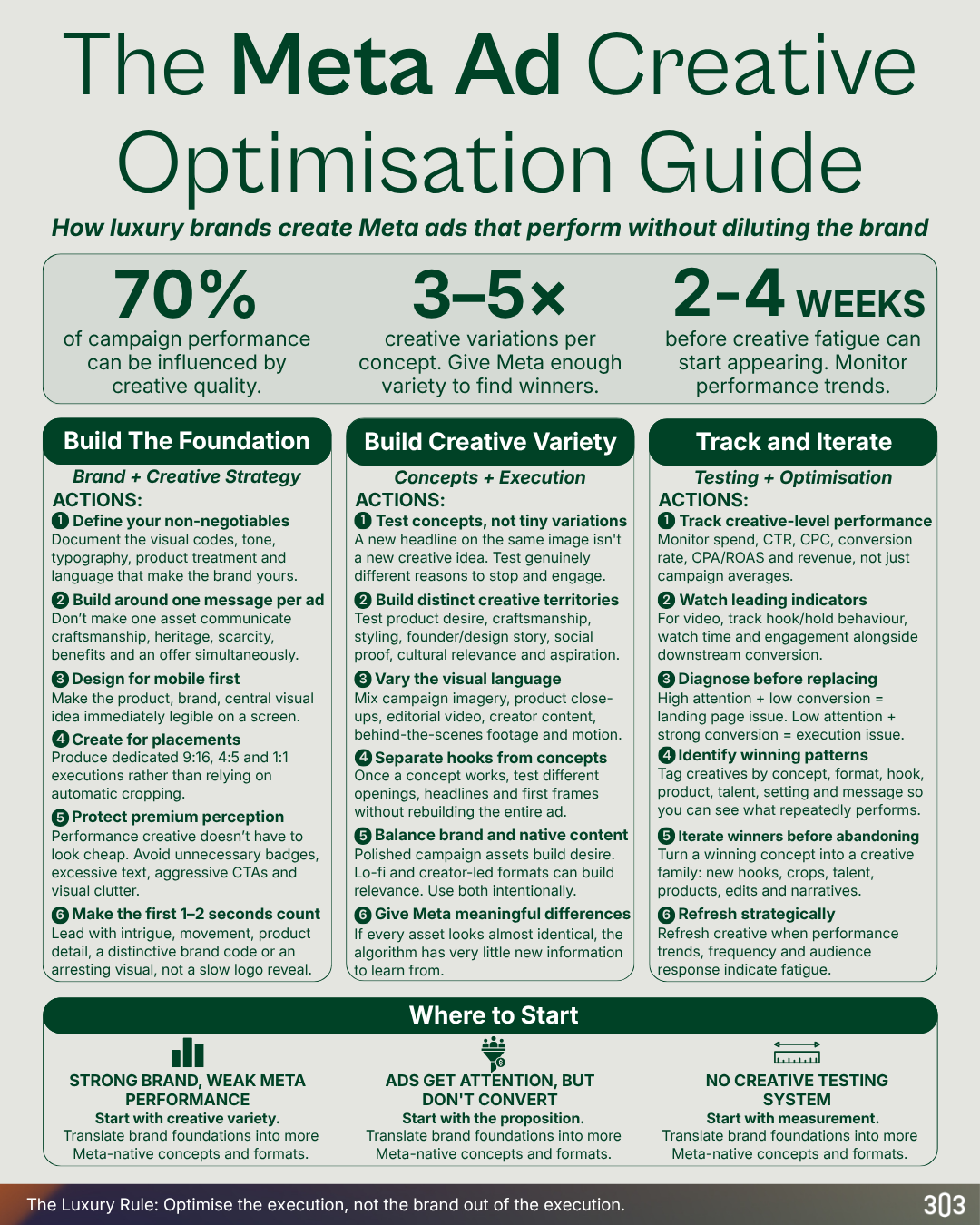
70% of campaign performance can be influenced by creative quality. That single stat shapes everything we do at 303 when we build Meta campaigns for premium and luxury brands. The algorithm, the bidding strategy, the audience targeting: all of it matters, but creative is the lever with the most pull.
We put together a framework that breaks the problem into three pillars: building the right creative foundation, developing genuine variety, and tracking performance in a way that tells you what to do next. This post walks through each one.
Pillar One: Build the Foundation
Before you write a single brief or produce a single asset, you need to know what is and isn't negotiable about your brand on Meta. This is what we call the foundation layer, and skipping it is the most common reason luxury brand campaigns underperform.
Define your non-negotiables
Every premium brand has a set of visual codes, a tone, a product treatment, and a typographic language that makes it recognisable. Document them explicitly for Meta. Not just "we're a luxury brand" but: what does our product look like in frame? What language do we use and avoid? What emotional register are we always in?
These non-negotiables become your guardrails for every creative decision downstream.
One message per ad
This sounds obvious but it's routinely ignored. A single ad cannot credibly communicate craftsmanship, heritage, scarcity, product benefits, and a promotional offer at the same time. Pick one. The ads that try to do everything end up communicating nothing, and they look cluttered, which is the fastest way to signal "this brand is not premium."
The practical checklist
When we're building out the foundation for a luxury Meta account, we run through six actions before a single asset goes into production:
- Define the non-negotiables for visual codes, tone, typography, and product treatment
- Assign one message per ad so each creative has a single, clear reason to stop and engage
- Design for mobile first so the product, brand, and central idea are legible on a small screen
- Produce for placements with dedicated 9:16, 4:5, and 1:1 executions rather than relying on automatic cropping
- Protect premium perception by removing unnecessary badges, excessive text, and aggressive CTAs
- Make the first 1-2 seconds count with intrigue, movement, product detail, or a distinctive brand code, not a slow logo reveal
The Luxury Rule: Optimise the execution, not the brand out of the execution.
That last point is worth sitting with. The instinct when performance dips is to add more: more text, more urgency, more offer. For luxury brands, the answer is almost always the opposite. Strip back to what makes the brand compelling and let the creative breathe.
Pillar Two: Build Creative Variety
Once the foundation is solid, the next job is giving Meta enough material to find winners. This is where most luxury brands either over-constrain themselves (producing one polished hero asset and calling it a campaign) or go in the wrong direction (producing slight variations of the same asset and wondering why performance doesn't improve).
The target is 3-5 genuinely different creative variations per concept. Not five versions of the same image with different headlines. Five different reasons for someone to stop scrolling.
Test concepts, not tiny variations
A new headline on the same image is not a new creative idea. The algorithm needs meaningfully different inputs to learn from. What you're testing are distinct emotional entry points: product desire, craftsmanship, founder story, design story, social proof, cultural relevance, aspiration. Each of these is a different creative territory, and they attract different audiences within your target.
What "variety" actually looks like
Creative variety for a luxury brand doesn't mean abandoning the visual standards from your foundation. It means varying the format and the angle while keeping the brand codes intact.
- Creative territory: Product desire — Format examples: Campaign imagery, close-up product detail
- Creative territory: Craftsmanship — Format examples: Behind-the-scenes footage, editorial video
- Creative territory: Social proof — Format examples: Creator-led content, customer perspective
- Creative territory: Cultural relevance — Format examples: Styling content, contextual lifestyle
- Creative territory: Aspiration — Format examples: Motion, editorial, brand world storytelling
Separate hooks from concepts
This is one of the more nuanced points in the framework and one of the most valuable in practice. Once a concept is working, you don't need to rebuild the whole ad to test a new opening. Test different first frames, different headlines, different opening lines. The concept stays intact; only the hook changes.
This approach dramatically increases your testing velocity without requiring a new shoot every time.
Balance brand and native content
Polished campaign assets build desire. Lo-fi and creator-led formats build relevance. Both have a place in a luxury Meta account, and the brands that use both intentionally tend to outperform those that commit to only one. The key word is intentionally: lo-fi content should feel considered, not like a cost-cutting measure.
Pillar Three: Track and Iterate
The third pillar is where most brands leave money on the table. They run creative, look at ROAS, make a gut-feel decision, and either kill or scale. The problem is that ROAS alone doesn't tell you why something is or isn't working, which means you can't improve it systematically.
Creative fatigue typically starts appearing within 2-4 weeks. That's not a long runway. If you're not watching the right signals, you'll be reacting to problems that are already weeks old.
Track at the creative level
Campaign-level averages mask what's actually happening. You need to be tracking spend, CTR, CPC, conversion rate, CPA, ROAS, and revenue at the individual creative level. When one ad in a campaign is dragging down the average, you need to see it clearly enough to act on it.
For video specifically, watch time and hook rate (the percentage of people who watch past the first 3 seconds) are leading indicators that tell you whether a problem is creative or downstream before your conversion data catches up.
Diagnose before you replace
This is the diagnostic logic we apply before making any creative decision:
- High attention + low conversion = landing page issue. The creative is doing its job; the problem is what happens after the click.
- Low attention + strong conversion = execution issue. The concept is strong but the opening isn't landing. Test new hooks before scrapping the concept entirely.
Getting this diagnosis right saves significant production budget. Many brands kill winning concepts because the hook wasn't working, when a new first frame would have solved the problem.
Build creative families from winners
When a concept proves itself, don't just run it until it fatigues. Turn it into a creative family: new hooks, crops, talent, products, edits, and narratives all built around the same proven concept. This extends the life of your best ideas and gives Meta more material to work with.
Tag your creatives by concept, format, hook, product, talent, setting, and message from the start. Over time, you'll be able to see what combinations repeatedly perform, and that pattern becomes your creative brief for the next round.
When to refresh
Refresh creative when performance trends, frequency data, and audience response indicate fatigue, not on an arbitrary calendar schedule. Some concepts run for six weeks; some fatigue in ten days. Let the data tell you, but make sure you're watching the right data to hear it.
Where to Start
The framework applies regardless of where you are right now. The starting point just changes depending on your current situation:
- Strong brand, weak Meta performance? Start with creative variety. Your brand foundations are likely solid; the problem is that Meta doesn't have enough genuinely different concepts to learn from.
- Ads getting attention but not converting? Start with the proposition. Creative is doing its job of stopping the scroll; the message or the landing experience isn't closing the gap.
- No creative testing system in place? Start with measurement. You can't improve what you can't see clearly. Get your creative-level tracking set up before you invest in more production.
In every case, the underlying principle is the same: optimise the execution, not the brand out of the execution. Meta can be an exceptional channel for luxury brands. The ones that make it work treat creative as a strategic discipline, not a production task.
If you're working through any of these challenges, we'd be glad to talk through your Meta creative strategy.